Franking credits explained for Australian investors
15 June 2026 · Girish Patil · Founder, Metrifly · Updated 24 June 2026
Founder of Metrifly. Writes about Australian portfolio tracking, CGT, dividends, and tax reporting for self-directed investors.

If you own Australian shares, you’ve probably seen “franking credits” on a dividend statement and wondered what they actually do. The short version: they stop the same profit being taxed twice, and for some investors they turn into a cash refund. This guide explains how they work, with a worked example, and how to keep track of them at tax time.
This is general information, not tax advice. Check your own situation with a registered tax agent or the ATO.
What are franking credits?
A franking credit (also called an imputation credit) is your share of the company tax already paid on a profit that’s then paid to you as a dividend. When an Australian company earns a profit, it pays company tax (usually 30%, or 25% for a base-rate entity). When it then pays you a dividend out of that already-taxed profit, it attaches a franking credit representing the tax it already paid. (See the ATO’s guidance on franking credits.)
This is Australia’s dividend imputation system. The idea is simple: profit shouldn’t be taxed once in the company’s hands and again in yours. The franking credit is your share of the tax already paid, and you use it to offset the tax on that dividend.
A dividend can be:
- Fully franked — the full company tax has been paid; it carries the maximum franking credits.
- Partially franked — only part of the dividend carries credits.
- Unfranked — no company tax was paid on it (common for income the company didn’t pay Australian tax on), so no credits are attached.
The gross-up, with a worked example
You declare the grossed-up amount — the cash dividend plus the franking credit — not just the cash. You’re taxed on that total, and the franking credit comes off your tax bill.
Take a $70 fully franked dividend at the 30% company tax rate:
| Step | Amount |
|---|---|
| Cash dividend you receive | $70 |
| Franking credit attached | $30 |
| Grossed-up (taxable) income | $100 |
The franking credit is calculated as:
franking credit = cash dividend × (company tax rate ÷ (1 − company tax rate))
At 30%, that’s $70 × (0.30 ÷ 0.70) = $30. You declare $100 of income, and you have a $30 credit to put against the tax on it.
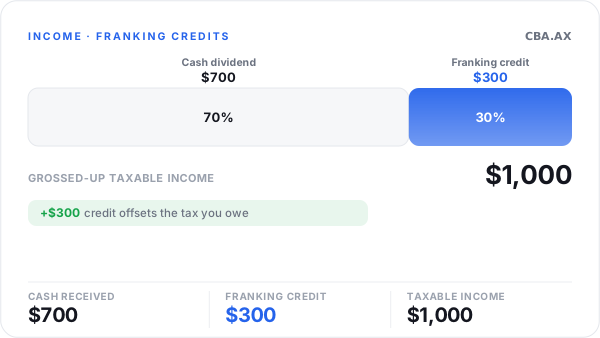
The cash dividend plus the franking credit is the grossed-up income you declare — and the credit comes back against your tax.
For a partially franked dividend, you scale the credit by the franked percentage. A 50%-franked $70 dividend carries half the credits — $15.
How to work out franking credits (the formula)
To work out franking credits on any dividend, use the imputation formula:
franking credit = cash dividend × (company tax rate ÷ (1 − company tax rate)) × franked %
Step by step:
- Find the gross-up factor from the company tax rate. At 30% it’s
0.30 ÷ 0.70 = 0.4286; at the 25% base-rate it’s0.25 ÷ 0.75 = 0.3333. - Multiply the cash dividend by the gross-up factor to get the credit on a fully franked dividend.
$70 × 0.4286 = $30. - Scale by the franked percentage if it isn’t fully franked. A 60%-franked $70 dividend (30% company tax) carries
$30 × 0.60 = $18in credits. - Add the credit to the cash to get the grossed-up income you declare.
$70 + $30 = $100.
That’s the whole calculation for a single dividend. To skip the arithmetic, drop the numbers into our franking credit calculator.
Who comes out ahead?
What happens next depends on your marginal tax rate, because the franking credit is a refundable tax offset:
- Your rate is below the company rate (say a retiree on a low rate, or an SMSF in pension phase paying 0%): the $30 credit is more than the tax on the $100, so the excess is refunded to you in cash.
- Your rate equals the company rate (~30%): the credit roughly cancels the tax — you pay little or nothing extra.
- Your rate is above the company rate (say 39% incl. Medicare): the credit covers most of the tax, and you top up the difference.
This is why franked dividends are especially valuable to low-rate investors and SMSFs — the credits can become a refund rather than just an offset.
Here’s the same $70 fully franked dividend ($100 grossed-up, $30 credit) across a range of marginal tax rates:
| Your marginal rate | Tax on $100 grossed-up | Less $30 credit | Result |
|---|---|---|---|
| 0% (SMSF pension phase) | $0 | −$30 | $30 refund |
| 19% | $19 | −$30 | $11 refund |
| 30% | $30 | −$30 | nil — credit cancels the tax |
| 37% | $37 | −$30 | $7 to pay |
| 45% | $45 | −$30 | $15 to pay |
Figures are illustrative marginal rates on the grossed-up amount and exclude the Medicare levy and offsets; your actual position depends on your full return.
What your broker statement does not show clearly
The hard part is rarely one dividend. It is the year-end reconciliation:
| Record | Why it matters |
|---|---|
| Cash dividend | The amount paid to you or reinvested through a DRP. |
| Franked amount | The part of the dividend that carries credits. |
| Unfranked amount | Still assessable income, but no credit is attached. |
| Franking credit | The refundable tax offset and the amount included in the gross-up. |
| Payment date and holding period | Needed when checking whether the 45-day rule is relevant. |
If you hold ETFs, the dividend-like cash distributions can also arrive with AMMA statement components after 30 June. That is where many spreadsheets go wrong: the cash paid during the year is not always the final taxable income figure.
Two rules worth knowing
The 45-day holding rule. To claim franking credits, you generally need to hold the shares “at risk” for at least 45 days (90 days for certain preference shares), not counting the days you bought and sold. It’s designed to stop people buying just before a dividend and selling straight after to harvest the credits.
The small shareholder exemption. If your total franking credits for the year are $5,000 or less, the 45-day rule doesn’t apply to you. Most individual investors fall under this threshold.
How to track franking credits
Across a real portfolio — multiple holdings, DRPs, partially franked dividends, dividends paid through the year — adding this up by hand is tedious and error-prone.
- Estimate a single dividend with our free franking credit calculator — enter the dividend, the franked percentage, and your rate to see the credit, the grossed-up income, and whether you’d pay tax or get a refund.
- Track your whole portfolio with Metrifly’s dividend tracker, which attaches franking credits to every dividend automatically and rolls them into your tax reports with the franked/unfranked split and myTax labels.
- If your ETF sends an AMMA statement after year end, use the AMMA / AMIT guide to separate attributed income from cost-base adjustments before lodging.
For capital gains, see capital gains tax on shares or estimate one sale with the CGT calculator. For EOFY prep, see our EOFY checklist.
Frequently asked questions
What are franking credits? Franking credits (imputation credits) represent the company tax already paid on profits distributed to you as a dividend. You use the credit to offset the tax on that dividend, so the same profit isn’t taxed twice.
How do you work out franking credits? Franking credit = cash dividend × (company tax rate ÷ (1 − company tax rate)), scaled by the franked percentage. A fully franked $70 dividend at 30% carries $70 × (0.30 ÷ 0.70) = $30.
What is the franking credit formula? franking credit = cash dividend × (company tax rate ÷ (1 − company tax rate)) × franked %. At a 30% company tax rate the gross-up factor is 0.30 ÷ 0.70 ≈ 0.4286.
Who gets a franking credit refund? Investors whose marginal rate is below the company tax rate — retirees on low rates and SMSFs in pension phase (0%) — can have excess credits refunded in cash, because the credit is a refundable offset.
What is the 45-day holding rule? You generally must hold the shares “at risk” for at least 45 days (90 for certain preference shares), excluding buy and sell days — unless your total franking credits for the year are $5,000 or less.
Summary
Franking credits are the imputation system working as intended: company tax already paid, passed through to you, used to avoid double taxation — and refunded when your rate is low enough. Declare the grossed-up amount, apply the credit, mind the 45-day rule if your credits top $5,000, and let your portfolio tracker do the per-dividend arithmetic.
Try the franking credit calculator, then start tracking for free.